
The reality and future of physical AI robots: How humanoids will transform the workforce and imagination.

The reality and future of physical AI robots: How humanoids will transform the workforce and imagination.
You've probably seen countless demo videos over the past year showing humanoid robots walking nimbly, sorting packages, and conversing with people. And each time, many of you have likely felt the same way.
"That sounds amazing. But, in reality, how far have they come?"
This article aims to answer that question. We at iPresence have been working on the implementation of telepresence robots and autonomous robots for over 10 years. From that perspective, we will organize the "current stage of general implementation," the "stage of research and development" and the "technologies that are likely to emerge in the future" of physical AI.
Any descriptions of the future will be clearly stated as predictions. The value of this article lies in how companies on the front lines of implementation interpret the future in their own words.
What is Physical AI? — iPresence's Definition
First, let's briefly summarize the premise.
iPresence defines physical AI as follows:
Physical AIThis refers to a system with self-judgment capabilities that can either input (understand) or output (engage) with respect to the physical world.
This definition includes two points that were intentionally included.
The first point is the inclusiveness of "both or one." Discussions about physical AI tend to focus too much on the "output" side—the actions and tasks—of robots interacting with the physical world. However, physical AI can function and create value even if it's only through "input"—that is, by observing the situation with cameras and sensors, understanding the situation, and making judgments. This perspective is essential for correctly understanding "physical AI currently being implemented," which will be discussed later.
The second is "self-judgment function." This is the dividing line between conventional automation, which simply repeats pre-programmed actions precisely, and physical AI. It must sense changes in the environment and make its own judgments and actions according to the situation. Only with this property can it be operated in the unstructured real world.
The rapid spread of the term "physical AI" is largely due to key players in the AI industry, including NVIDIA, proposing that "the next stage in the evolution of AI is the physical world." While generative AI, exemplified by ChatGPT, deals with information in the digital space (text, images, code), physical AI deals with recognition and behavior in the real world—this is the common distinction. Our definition does not contradict this distinction; however, from the perspective of the "implementers," we have rephrased it in a broader and more practical way.

[Current Situation] Physical AI currently implemented in general
So, to what extent will physical AI be implemented in society by 2026?
Speaking from conclusion,"Structured environment × Limited tasks"Under these conditions, physical AI is already in the practical application stage.
Let me give you a specific example.
- Autonomous mobile robots (AMRs) for logistics warehouses: Transport items while avoiding obstacles and people in an environment where shelves and aisles are somewhat organized.
- Commercial cleaning robots: Maps the floors of offices and commercial facilities and autonomously creates cleaning routes.
- delivery robotAutonomous delivery in semi-structured environments such as sidewalks and inside facilities.
- Autonomous patrol and inspection robots: Autonomously navigates factories and plants, reading meters and detecting anomalies.
- Facility guidance robot: In showrooms and factories, it detects visitors and provides guidance while autonomously driving.
- Surgery support robot: High-precision assistance for human operation and automates some actions.
We will also provide our own implementation example as primary source information on this reality. iPresence's Field Log is a system in which autonomous robots patrol the factory, read analog meters, and determine the status of equipment. This is an "input (understanding) type" physical AI as defined earlier. The robot does not alter the physical world, but by observing, understanding, and making judgments on-site, it reduces the time that humans would have spent patrolling and the risk of overlooking something.
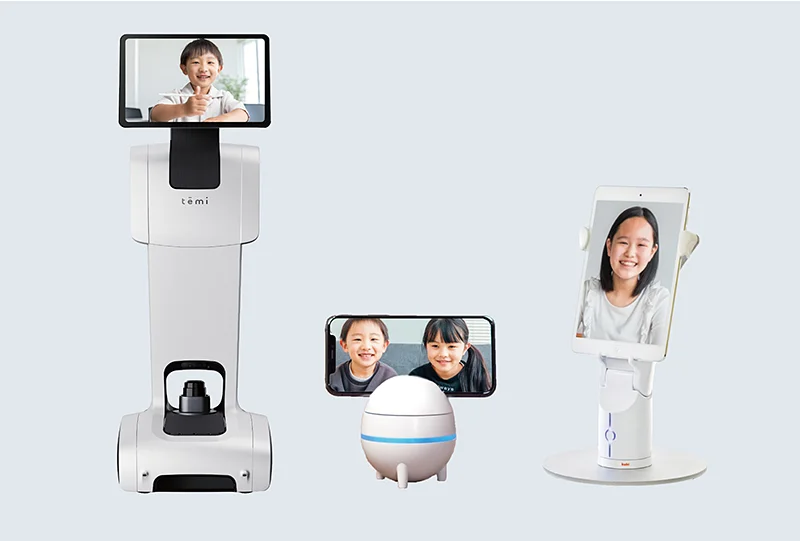
Furthermore, the automated factory tours and showroom guidance provided by the autonomous robot temi is an "input + output" type system. It understands the visitor's location and reactions (input), moves at the appropriate time, provides explanations, and guides them (output). What's important here is that the guidance task fulfills the conditions that current physical AI excels at: "the environment can be prepared to some extent" and "the scope of the task can be defined."
These implementation examples reveal some little-known facts.
If the environment and task are chosen appropriately, robots' "self-judgment" has already reached a practical level.
Physical AI is not a "technology of the future." If you select the right conditions, it's a "technology that's already in operation." Understanding this current situation will form the basis of all subsequent discussions.

What have humanoids changed? — Not "labor force," but "imagination."
However, the reason the term "physical AI" has attracted so much attention is not because of patrol robots or cleaning robots. It's because of the emergence of humanoid robots.
Here is our assessment.
The greatest contribution that humanoids have made to society at present is not "labor force," but "reality."
Images of human-shaped robots standing, walking, and grasping objects easily allow anyone to imagine a future where "robots work in place of people, or as an extension of the workforce." The biggest reason why physical AI has seemed like "a story of the distant future" until now is not so much the immaturity of the technology,People couldn't concretely imagine what they would entrust to robots.It was there. The humanoid form functioned not as a vessel for performance, but as a vessel for imagination.
On the other hand, we must be realistic in our assessment of the current situation. Humanoid robots are still in the early stages, with their "shape" and "movement" only just beginning to take shape. While factory trials have begun, the honest assessment from those on the front lines of implementation is that it is still too early to entrust them with actual "work" reliably as of 2026.
However—and this is the important part—as people gain a concrete image of what they want to do, the tasks that are suitable to be delegated and the tasks that people want to delegate begin to become clearer all at once. And once the tasks to be delegated become clearer, development goals can be defined, the collection of necessary data can begin, and development accelerates.
In other words, we predict that this kind of cycle is starting to take shape.
- The emergence of humanoids brings people's imaginations to life.
- A list of "tasks to be delegated" is created.
- Defining the tasks helps to establish development goals and data collection.
- The scope of tasks that can be delegated expands in cycles of several years.
- Expanded capabilities inspire further imagination.
Technology does not create demand,The materialization of imagination drives development.I believe this reversal of order is the true impact that humanoids have had on physical AI as a whole.

Another axis of evolution: AI agent managers that govern "decision-making."
When following the evolution of physical AI, many people tend to focus only on the "body"—that is, the shape and movement of the robot. However, there is another trajectory to its evolution.The trajectory of "judgment".
AI agents based on LLM (Large-Scale Language Models) have matured rapidly in recent years. This decision-making intelligence is beginning to function as an "AI agent manager" in the world of physical AI.
- Information in cyberspace (business systems, schedules, instructions, knowledge),
- Information from the physical space (the situation, location, and images of the site captured by the robot's sensors)
It aggregates, organizes, and makes decisions in real time, and issues instructions to multiple robot groups.It is existence.
What's noteworthy here is that the two trajectories evolve at different rates. The "physical" trajectory—especially human-level dexterity—is still in its initial stages, while the "judgment" trajectory is maturing first.
This asymmetry leads to one conclusion, which is a prediction, but we believe it will happen with a high probability.
Before the "all-purpose body" is perfected, the era will come when a "smart command center" will lead existing specialized robot groups.
In other words, the realistic form of physical AI in the near future is not a single, all-purpose robot that looks exactly like a human. Instead, under the command of an AI agent manager, there will be autonomous driving robots, inspection robots, guidance robots, desktop robots, and more.The specialized aircraft work together as a mixed team.That's the situation. The smarter the decision-making class becomes, the more sufficient individual bodies become with dedicated machines—in fact, in terms of cost and reliability, dedicated machines often come out on top.

Why are "being able to do something" and "being used" different? — Three perspectives for a calm and objective view
Even after considering everything discussed so far, there are still three key structural elements to keep in mind in order to calmly assess physical AI. This is because there is a clear gap between what can be done in a demo video and what can be used in real-world situations.
1. The technological barrier – Data in the physical world does not scale.
There is a well-known paradox in AI research: intellectual tasks that appear complex to humans (calculations, writing, chess) are relatively easy for AI, while physical tasks that humans perform unconsciously (walking, grasping, pouring) are far more difficult for AI.
The rapid evolution of generative AI was possible because of the vast amount of text and image data available on the internet. However, data on physical actions in the real world is not readily available on the internet. Unless we actually operate robots or build sophisticated simulations, we cannot collect that data.Physical world training data does not scale like text.That's why the forefront of research and development is focusing on simulation learning and world models—approaches that recreate the real world in a virtual space and accelerate learning there—precisely to break through this barrier.
2. Rationality of Shape – Areas where being humanoid is unnecessary, or rather, inappropriate.
The strength of humanoids lies in their versatility: they can use environments designed for humans without modification. However, conversely,For individual tasks, it almost always loses to a dedicated shape.That's what it means.
First,Areas where a human form is not necessary.You don't need two legs to clean the floor. A human-sized body is physically unable to fit into ceiling spaces or pipes for inspection. For routine transport, AGVs and AMRs are faster, cheaper, and more reliable. Environments such as high places, underwater, and disaster sites are inherently unfavorable for the human body, so there is no reason to mimic the human body.
Furthermore, Areas where humanoid figures are actually inappropriateThere are other considerations as well. Considering the risk of a human-sized, human-weight mobile body tipping over in people's living spaces, a small, low-center-of-gravity, specialized machine is inherently safer. The more joints there are, the more potential failure points there are, moving further away from what is most important to those on the ground: "reliable operation every day." The near-future vision of a "combined team of a command center and specialized machines" described in the previous chapter is supported by the rationality of this shape.
3. Human Acceptance – Convenience does not necessarily translate directly into implementation.
And this is the most easily overlooked aspect, yet the most significant obstacle in implementation.Human psychological resistance and fear towards humanoids cannot be ignored.
The concept of the "uncanny valley" is well-known. It describes the phenomenon where, the more a robot resembles a human, the more its creepiness and unsettling nature suddenly increase at a certain point. However, from an implementation standpoint, what's truly important is the structure beyond that point.
The more human-like a robot becomes, the more people begin to evaluate it using "the same standards as humans." A slight unnaturalness in facial expression, a momentary delay in response, awkwardness in movement—things that no one would notice in a dedicated robot are transformed into "creepy" or "unpleasant" in a humanoid form. Personification raises expectations to human levels, and the gap between expectations and reality directly translates into psychological resistance.
Furthermore, resistance isn't solely a problem on the user's side. The concept of "replacing people" evokes in frontline workers the feeling that "they themselves are the ones being replaced." Even if management decides to implement the robots, it's the frontline workers who will be working alongside them every day.Whether a technology is accepted or not is determined not by its performance, but by the psychology of those on the ground.
We have been working with this structure in robot implementation settings for over 10 years. If we were to condense that experience into a single formula, it would look like this.
Implementation = Technical feasibility × Human acceptance
This is a multiplication problem. No matter how advanced the technology, if there is no acceptance, the answer is zero. Conversely, even if the functionality is limited, robots with a shape and behavior that can be reliably accepted in the field will steadily become established. The quiet penetration of cleaning robots and guidance robots into society is due not only to their performance but also, in part, to the "sense of security that comes from them not being human-like."

Nevertheless, the reason why this region is crucial for civilization
Physical AI faces several obstacles to implementation, including technological hurdles, limitations in shape, and the complexities of human psychology. However,Physical AI is a critically important technological field for the maintenance and development of future civilization.
For the "maintenance" of civilization
Japan's working population will continue to decline for decades to come. Who will be responsible for infrastructure inspection, elderly care, logistics, and factory maintenance? Simply answering this question by "hiring more people" is no longer mathematically sound.
Physical AI, in this context, is not a "convenient option to have,"Prerequisites for maintaining societyThis is how things are going. And Japan will be the first country in the world to seriously confront this question. This is a crisis, but at the same time, it is a historic position for Japan to become a pioneer in the implementation of physical AI.
For the "development" of civilization
Human activity has always been constrained by the body. We cannot approach dangerous places. We can only exist in one place at a time. When the body becomes tired, activity stops.
As physical AI matures, it means that humans will be gradually freed from these constraints. When people withdraw from dangerous tasks, distance loses its meaning, and human time is freed from simple repetition, where will that time and creativity go? This is not fantasy. As we saw in the first half of this article, the first steps have already begun in warehouses, factories, and showrooms.
For the "well-being of mind and body" of human beings
And this is the perspective we value most.
Physical AI refers to a group of technologies that offer the possibility of enabling humans living in the physical world to live more fulfilling lives, both mentally and physically.
The richness of the "body" is about being freed from physical burdens and dangers. The richness of the "mind" is more than that. It's about being able to "be present" in the classroom even while hospitalized. It's about feeling as if your family, who live far away, are "there" for you. It's about truly "participating" in places you wanted to go but couldn't. By having technology take on the role of understanding and engaging with the physical world, humans can transcend the limitations of their bodies and remain connected.
The ultimate unit of value for physical AI is neither efficiency nor labor savings,Human richnessThat's what we believe.

iPresence's Stance ── This is how we will act in 2026
Finally, let us clarify our own position.
iPresence is by no means hesitant about humanoids; on the contrary, we are very positive about them. In fact, we already provide technology for events that support humanoid exhibits. We are closely observing the value of humanoids as vessels for imagination, and their ability to expand over several-year cycles.
However, what we prioritize is the "implementation of a teleportation society." A society where people can "be" where they need to be, transcending the limitations of distance and physical ability, and where necessary tasks can be performed on the spot. Our mission is to not let this remain just a concept, but to implement it in real-world situations.
Entrusting that leading role to a humanoid robot is a bit too much of a burden for 2026 – that's the honest assessment from those working on implementation.
So, first,Stable robots such as self-propelled robots and desktop robotsWe will push forward with implementation. We will firmly establish the "self-judgment" capability, which is already at a practical level, in on-site applications such as guidance, inspection, and remote presence, while incorporating the maturation of the AI agent that forms the decision-making layer, and evolving it into an implementation that unites robot groups. Then, at the appropriate time when both the technology and acceptance are in place, we will begin to handle humanoid robots on a full scale.
We're not betting on the shape of the robot; we're betting on the advancement of human communication and well-being.

Summary ── Don't "wait," start from "the current form."
Let's conclude by reviewing the content of this article.
Physical AI is effective in structured environments and limited tasks.Already in practical useIt is located there. The emergence of humanoids has changed people's imagination before it has changed the workforce, and a cycle has begun in which the concretization of "tasks we want to entrust" has accelerated development. At the same time, a layer of "decision-making" in the form of AI agent managers based on LLM is developing, and we predict that the era will come when intelligent command centers will lead specialized robot groups before all-purpose bodies. However, implementation is not determined by technology alone. Implementation = technological possibility × human acceptability. Technology that forgets this formula will not take root in the field.
Physical AI is not a technology of the future that we must wait for. It is a technology that can start working today, provided we select the environment and tasks. And it is only through the accumulation of these step-by-step implementations that this group of technologies will transform into "the foundation of a civilization in which humans can live fulfilling lives, both physically and mentally."
The future predictions and views expressed in this article are based on predictions and opinions as of September 2026.


Related Articles Related article


